All projects · Euroleague Basketball
Standings prediction
From probability to certainty.
- Client
- Euroleague Basketball
- Year
- 2023
- Industry
- Professional sport / Basketball
- Role
- PM · Development · R&D
- Service
- Data science and custom software development
- Scope
- 18 teams · 34 rounds · 9 games per round
Summary
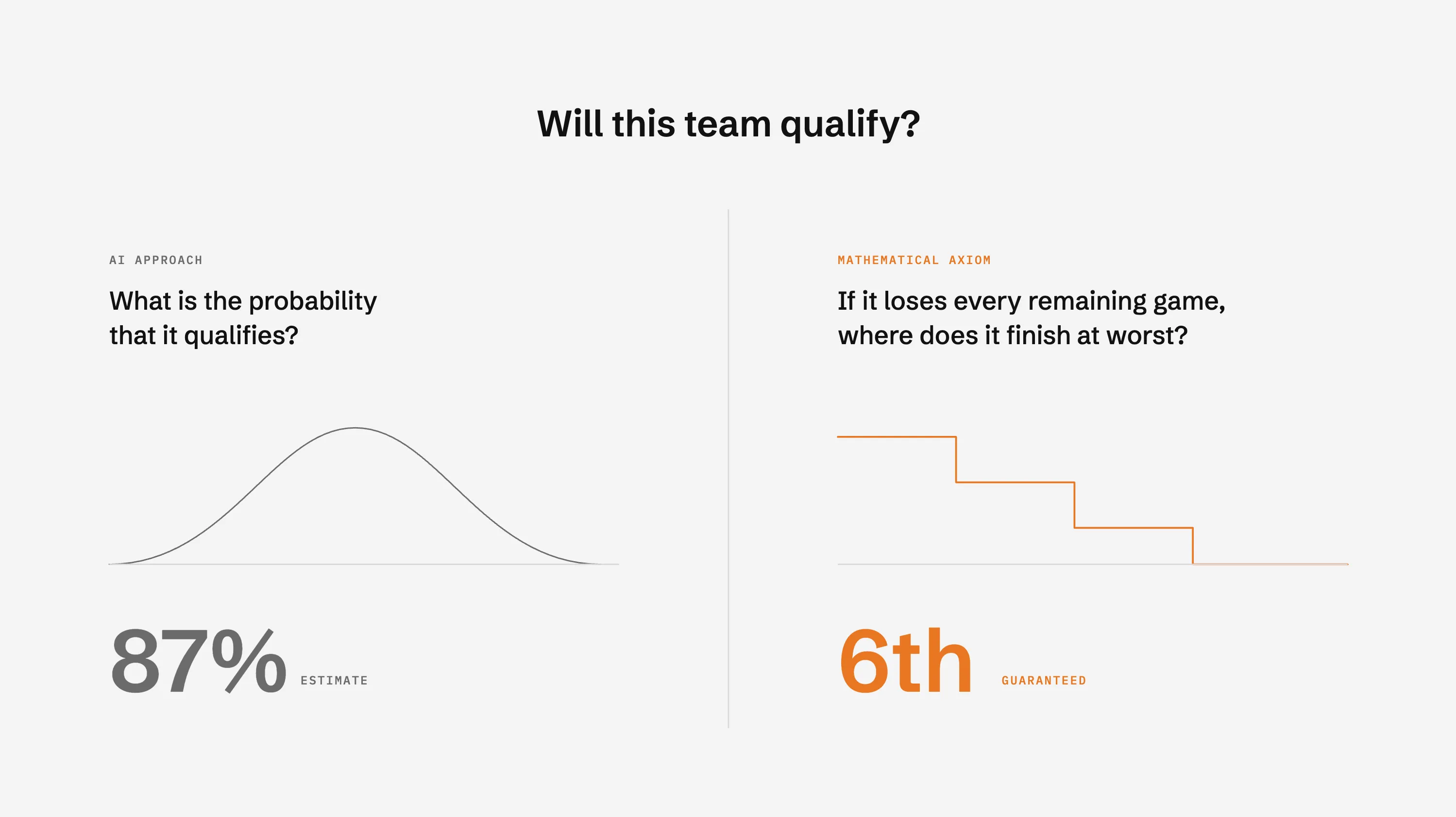
Cyberdelia built an engine for Euroleague that calculates, round by round, the worst possible position for every team if it loses all its remaining games. A mathematical answer, not an estimate.
The challenge
Euroleague needed to know, as early as possible, whether a team had already secured qualification for the next phase, and to be able to communicate it with complete reliability.
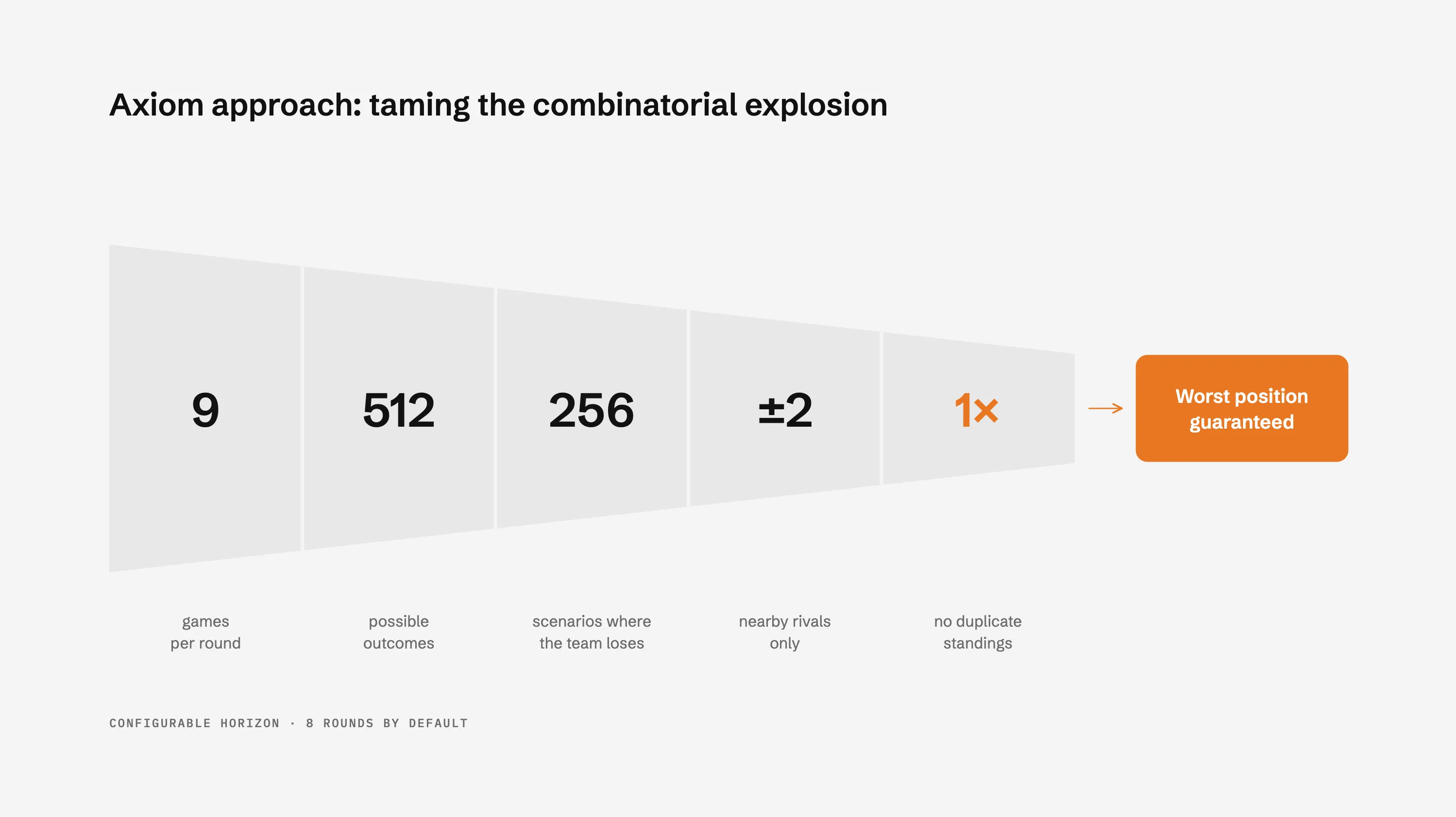
The problem is combinatorial. Each round has 9 games, meaning 512 possible combinations of results, and chaining several rounds makes the number of scenarios grow exponentially. On top of that, tie-breakers depend on the points scored in each game, a figure that wasn’t available in the source used.
The journey
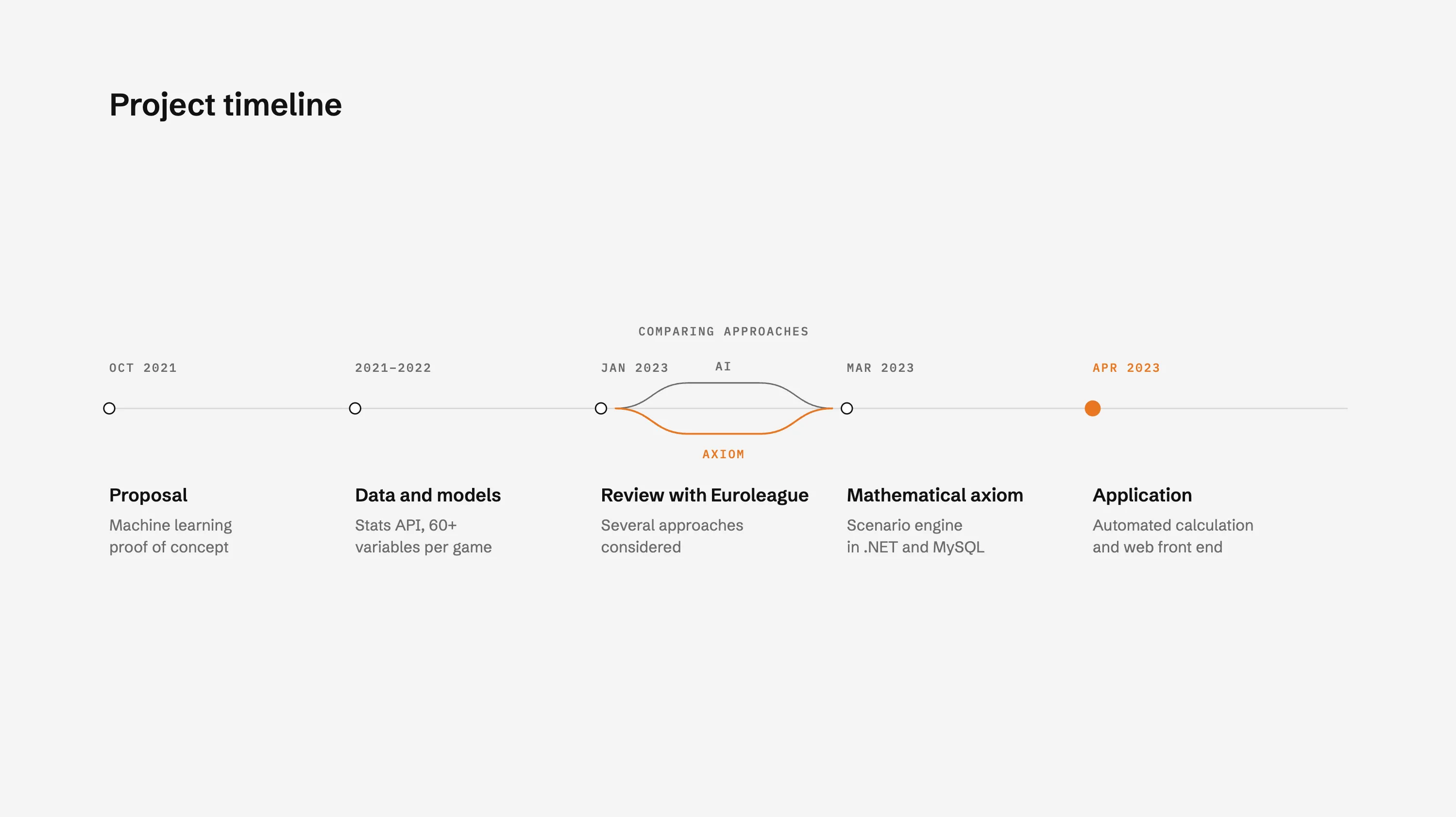
The project started in 2021 as a machine-learning proof of concept and, after the review with Euroleague in January 2023, evolved into exploring and comparing several approaches. Two of them define the case: a predictive AI model and a deterministic engine based on a mathematical axiom. Each answers a different question, and together they give Euroleague the full picture.
Approach 1 · AI prediction
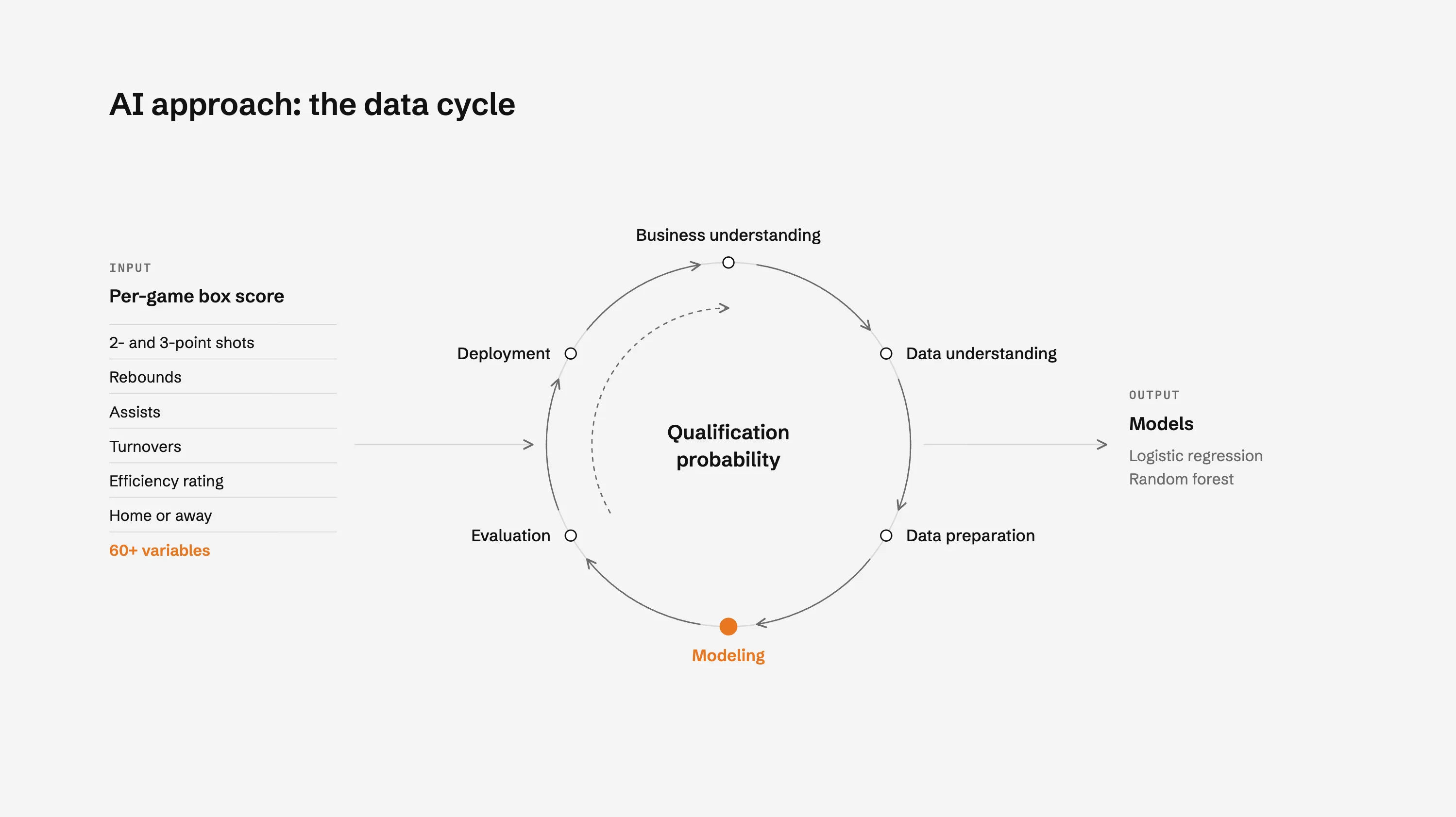
The first approach answers the question “what is the probability that a team qualifies?”. It followed the CRISP-DM methodology, in iterative cycles running from business and data understanding to modelling, evaluation and deployment.
The dataset was built from real data from Euroleague’s statistics API: more than 60 variables per game, such as 2- and 3-point shots, rebounds, assists, turnovers, efficiency rating or home/away. Logistic regression and random forest models were trained on it.
The result is a useful estimate for analysis, but a probability doesn’t allow anyone to officially state that a team has qualified.
Approach 2 · The mathematical axiom
The second approach changes the question: “if this team loses every remaining game, what is the lowest position it can finish in?”. The answer isn’t an estimate, it’s a certainty, and therefore it can be communicated.
Solving it meant taming the combinatorial explosion. Four design decisions made it feasible:
- Only scenarios in which the analysed team loses are kept, cutting the 512 combinations per round to a maximum of 256.
- The engine works with an adjustable window of two positions above and below, because distant teams don’t change the result.
- The horizon is parameterised, 8 rounds by default.
- Repeated standings are discarded to save computing time.
The solution
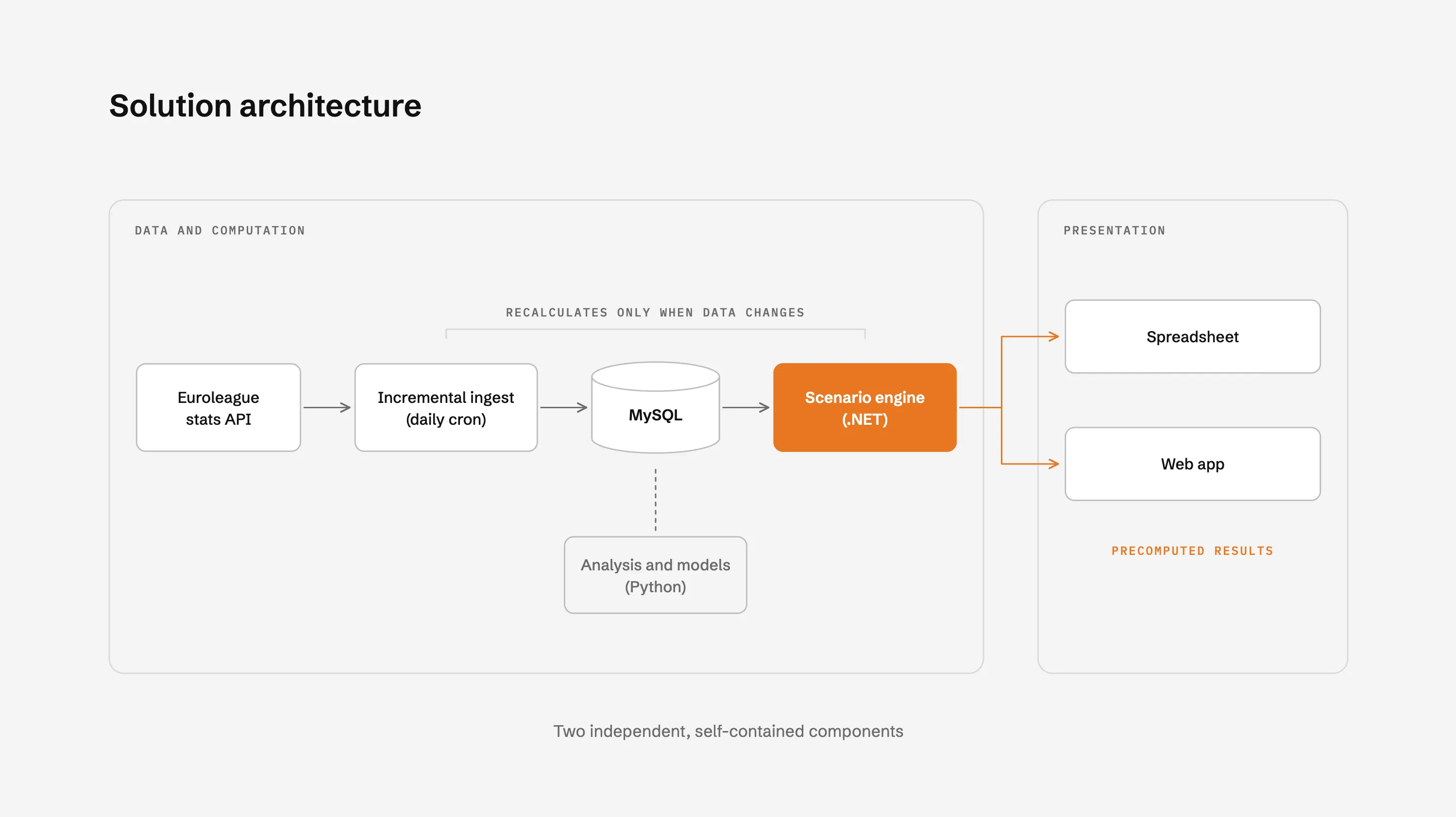
The application is made of two independent, autonomous pieces. The first connects incrementally to Euroleague’s statistics API, stores the data in MySQL and recalculates standings only when something changes, with a daily cron run. The second presents the pre-calculated results in a spreadsheet and a web application.
The algorithm, round by round
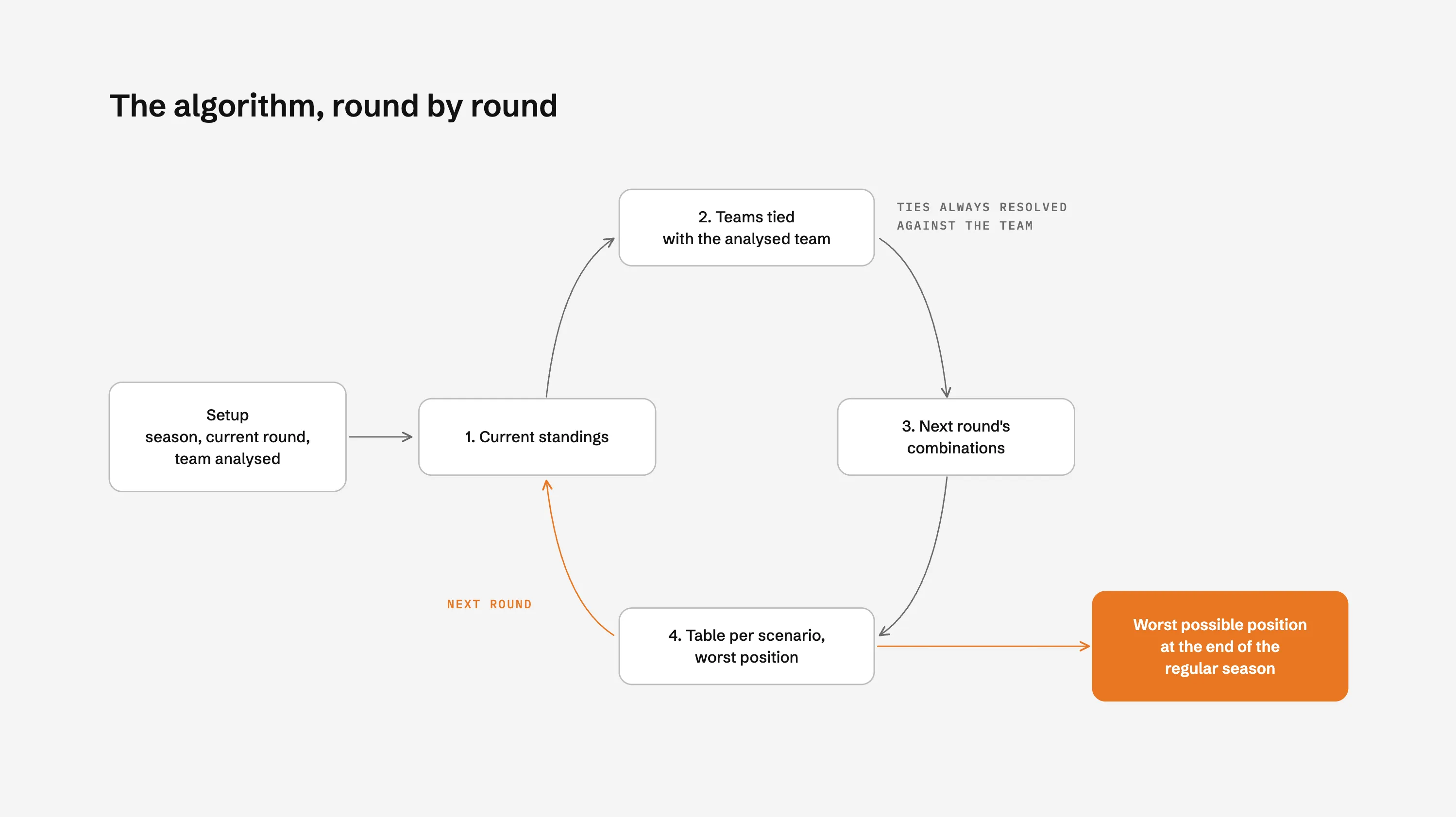
The algorithm takes the season, the current round and the team being analysed. For each round it gets the current standings, identifies the teams tied with the analysed one, generates every combination for the next round and builds a table for each scenario. From each it records the team’s worst position and, at the end, returns the worst possible position at the close of the regular season.
Since points per game weren’t available, ties are always resolved against the analysed team. The position returned is therefore a guaranteed pessimistic bound.

Results
With real data from round 28 of the 2022-2023 season, the system determined that Olympiacos would not drop below 6th place even if it lost all its remaining games.
| Team | Worst possible position | Status |
|---|---|---|
| Olympiacos Piraeus | 6th | |
| Real Madrid | 8th | |
| FC Barcelona | 8th | |
| Fenerbahçe Beko Istanbul | 10th | |
| AS Monaco | 11th | |
| Partizan Mozzart Bet Belgrade | 11th | |
| Cazoo Baskonia Vitoria-Gasteiz | 11th | |
| Zalgiris Kaunas | 12th | |
| Anadolu Efes Istanbul | 15th |
- Place guaranteed
- Depends on other results
- No guarantee
For each team, the tool details the round-by-round evolution: scenarios generated, worst position without ties, number of ties, teams involved and pessimistic final position. Euroleague got an immediate read of who has a guaranteed spot and who still depends on other results.
Why it worked
The value wasn’t in the most sophisticated model, but in framing the right question for the client. AI brings context and trend; the axiom brings the certainty an official announcement requires. Exploring and comparing both paths let Euroleague use each one for what it’s good at.
The deterministic solution relies on simple, explainable engineering decisions, so the result is transparent and auditable: anyone in the organisation can understand why a team is green. The intellectual property of the solution remained with Euroleague.
Stack
- .NET
- C#
- Python
- MySQL
- API estadística Euroleague