All projects · Liebherr
Material certificate quality control
So the quality team only looks at what doesn’t add up.
- Client
- Liebherr
- Year
- 2024 – present
- Industry
- Industry / Steel
- Role
- PM · UX-UI · Development
- Scope
- MVP · full development
- Format
- Internal web app
- Users
- Quality & purchasing

Dashboard
The quality team’s home view: verified volume, how much is resolved without intervention, open exceptions and which suppliers concentrate discrepancies.
Summary
Cyberdelia designed and built, end to end, a SaaS-ready MVP to automate the extraction, structuring and validation of critical information from technical steel documentation sent by suppliers. The goal: reduce manual work, accelerate document validation and improve materials traceability against ERP data.
Screens
Data shown is anonymized.
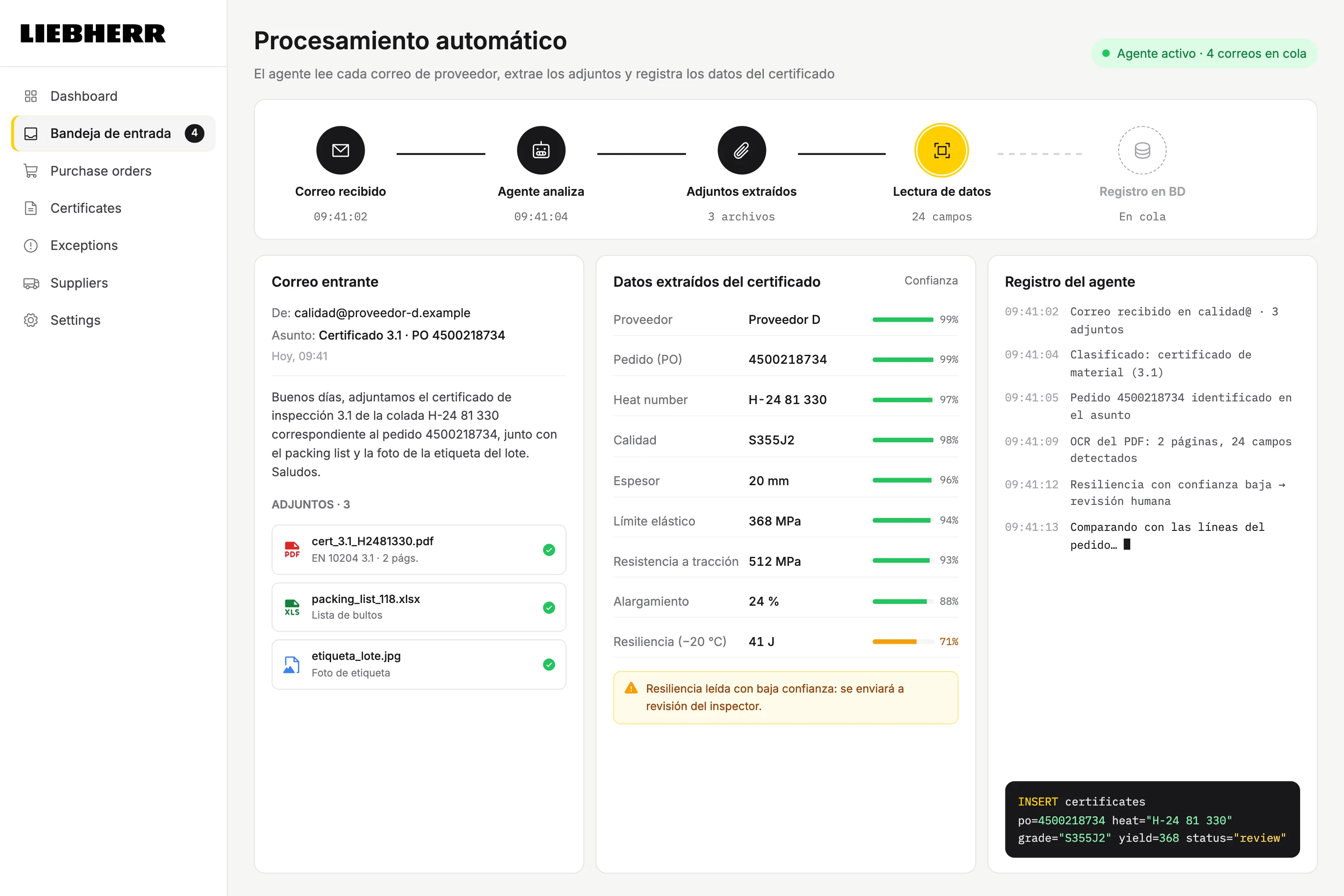
Email agent
The agent reads the supplier’s email, extracts the attachments and records the certificate values. Anything read with low confidence goes to human review.
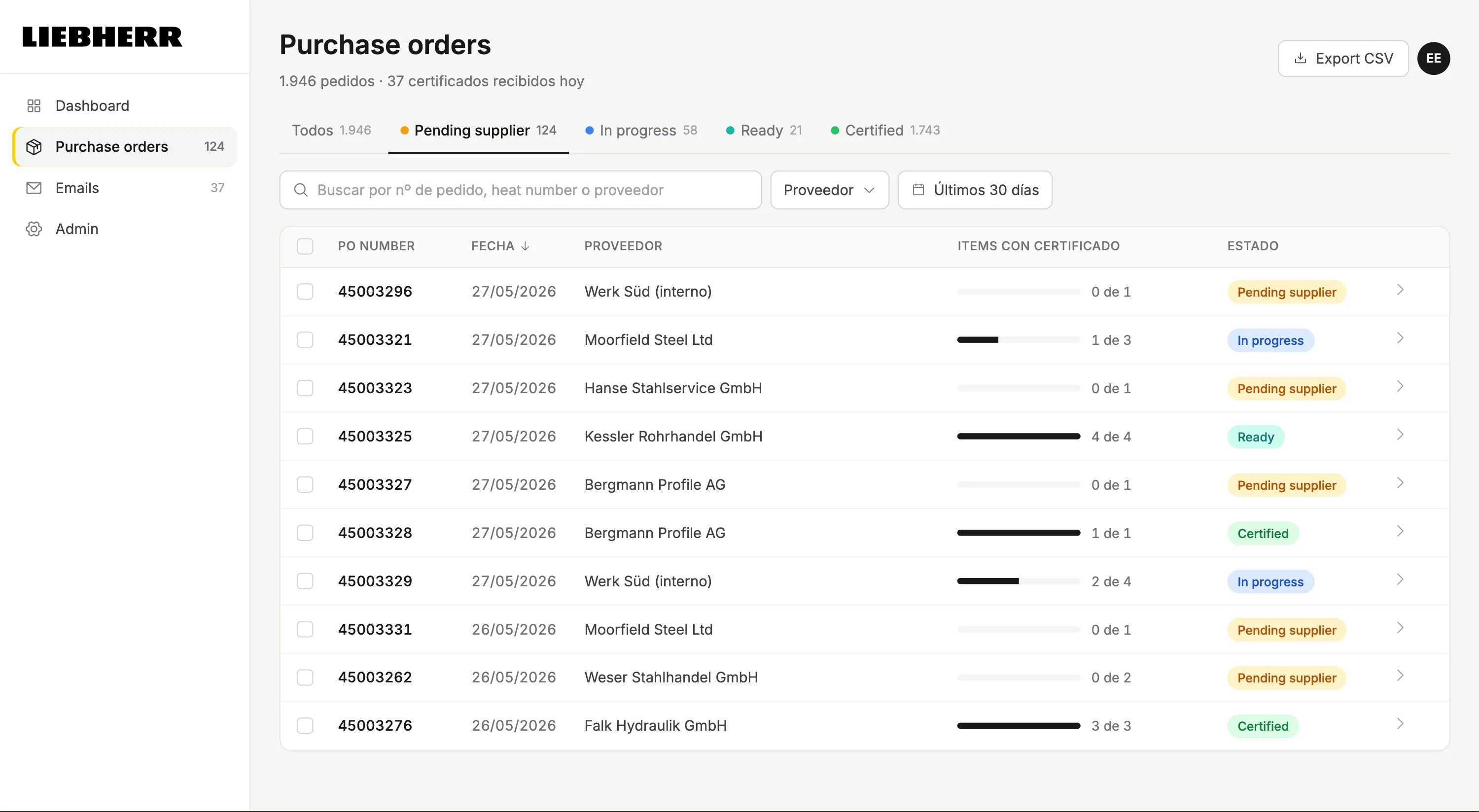
Purchase orders
Every order in one table, with status tabs and a bar showing how many lines already have a verified certificate.
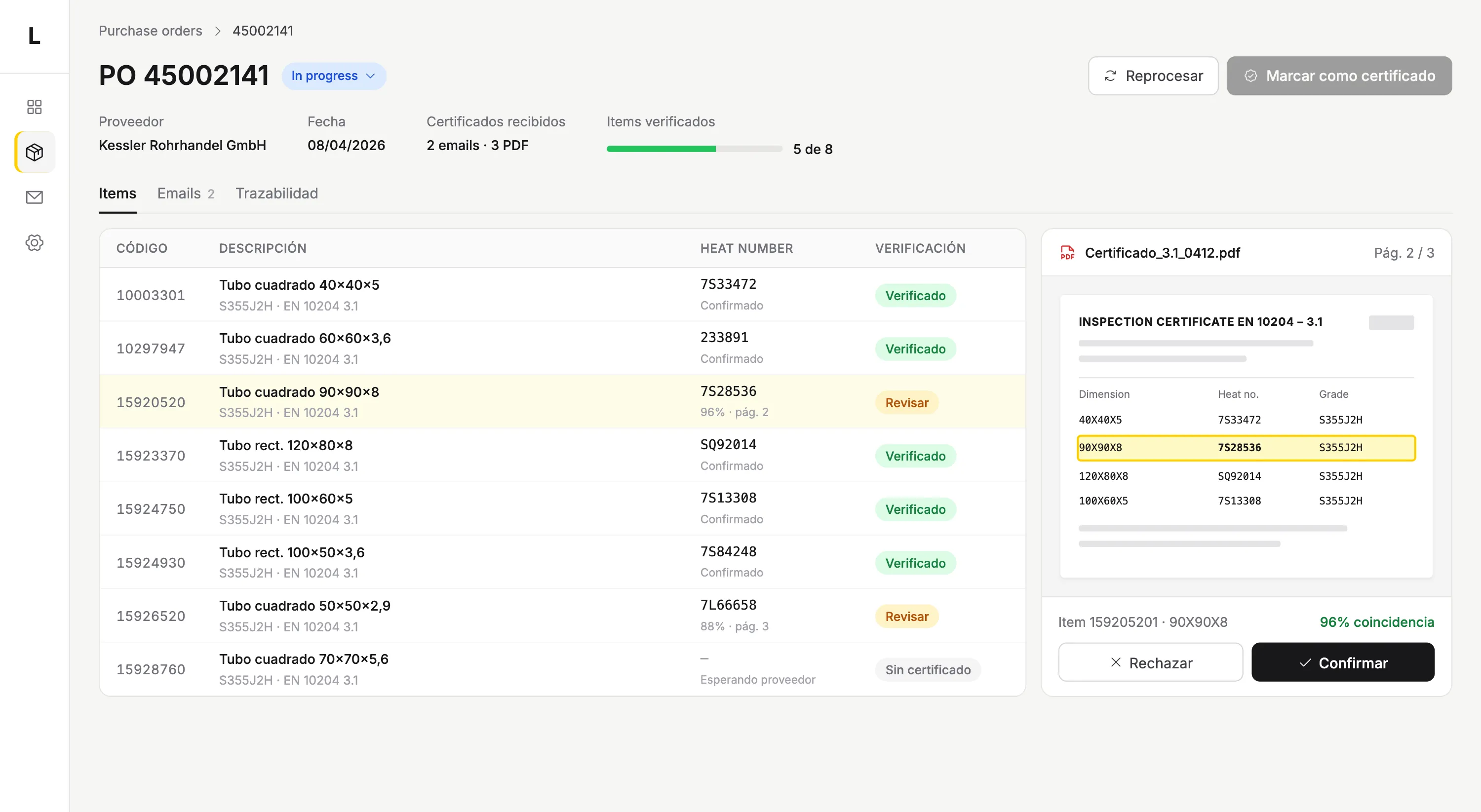
Verification against the certificate
Each order line against the certificate values: green when it matches, red when it doesn’t. The inspector only looks at the exceptions.
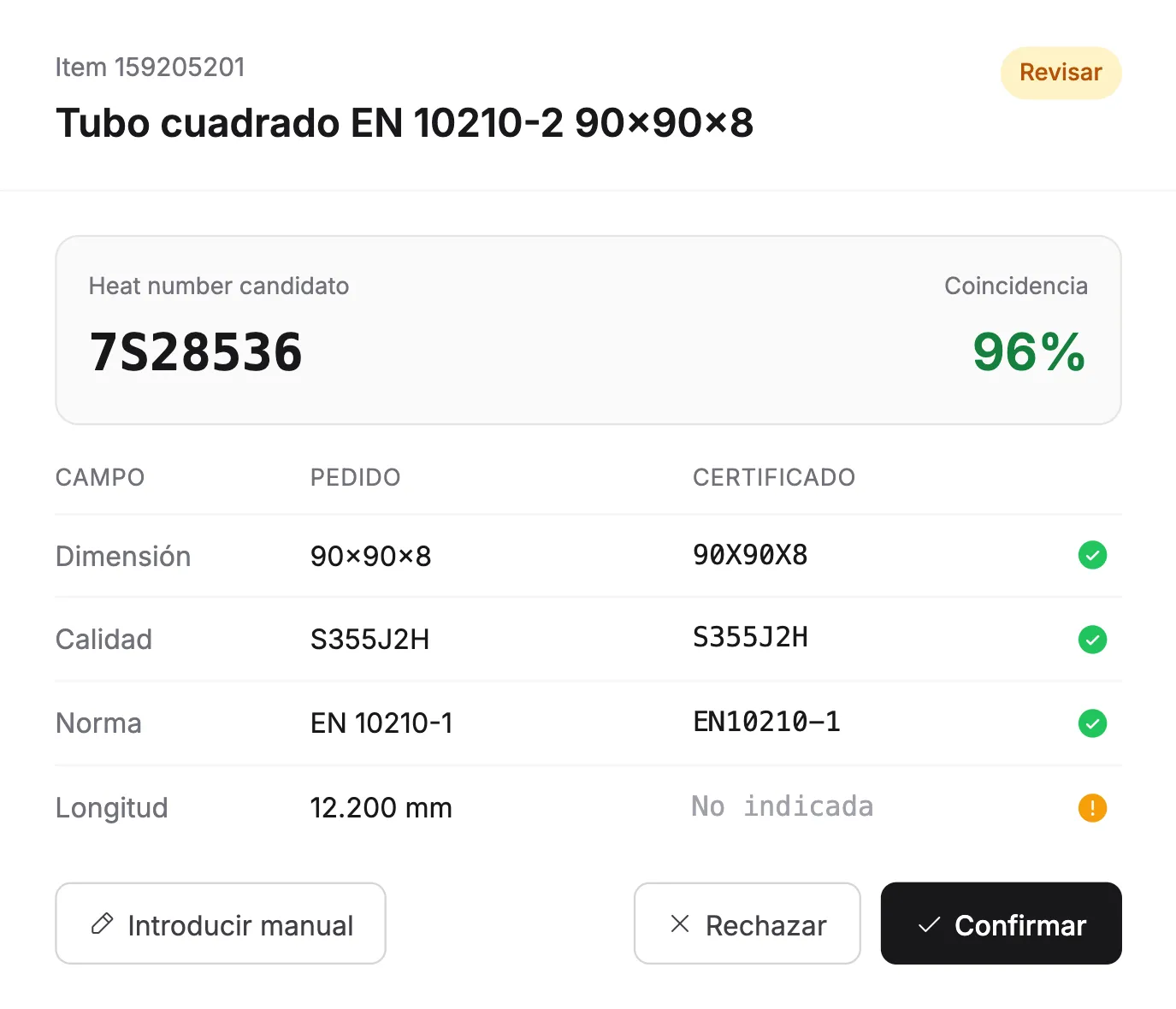
Heat number matching
The candidate heat number against the order line, field by field, with its match score. The inspector confirms, rejects or enters it manually.
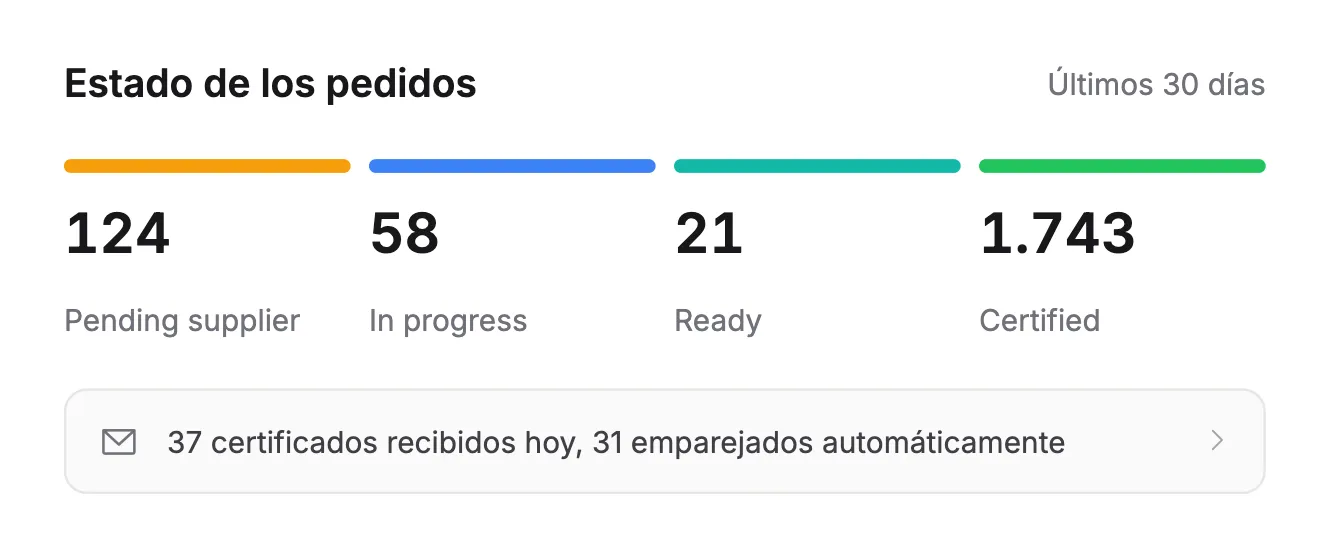
Status flow
Each order moves from Pending to Certified, and the team sees at a glance how many certificates arrived today and how many matched on their own.
The problem
In the industrial process, suppliers sent technical documentation associated with steel batches. That documentation arrived in inconsistent formats and required manual review to verify it matched operational and traceability requirements.
- High time investment in manually reviewing dense technical documentation.
- Risk of human error when interpreting data-heavy documents.
- Difficulty locating key fields consistently across different document formats.
- Low scalability of the process against growing document volume.
- Need to cross-reference document data against expected records in internal ERP systems.
Objective
- Automatically ingest documentation received by email — no manual intervention.
- Extract relevant data fields without human review.
- Structure that information in a machine-comparable format.
- Cross-reference it against expected ERP records.
- Present a clear result for validation and traceability sign-off.
- Let the quality team work by exception, not certificate by certificate.
Approach
A SaaS-oriented MVP, focused on one specific, measurable industrial use case. Not 'a nice AI chat' — an operational tool designed to automate a concrete, high-value task with industrial-grade reliability requirements.
What we built
Email agent
Suppliers send certificates by email. An agent classifies each message, extracts the attachments (PDFs, spreadsheets, label photos), reads the values with a confidence score and records them. Only low-confidence data reaches the inspector.
Order verification
Every purchase-order line is checked against the certificate values: dimensions, grade, standard, yield strength, impact energy… Green when it matches, red when it doesn’t, linked to the exact page of the PDF.
Heat number matching
The certificate’s heat number is matched to the order line with a match score. The inspector confirms, rejects or enters it manually.
Status flow with traceability
Each order moves from Pending to In progress, Ready and Certified, with a full history of who validated what and when.
Exceptions dashboard
Verified volume, share resolved without intervention, open exceptions and which suppliers concentrate the discrepancies.
Purchasing ERP integration
Orders and lines are read from the ERP; the verification result flows back to close the material traceability loop.
The role of AI
AI was the core of the solution — but its value wasn't in being AI. It was in solving a real operational problem. Its function was to interpret dense technical documentation and extract business-oriented information with the reliability an industrial environment demands.
- Identify relevant fields within unstructured technical documents.
- Normalize and standardize extracted information across document variants.
- Extract batch references, heat numbers and steel traceability data.
- Structure output in a format directly comparable with ERP records.
- Reduce manual review dependency for every document processed.
The challenge wasn't purely technical: it was getting the AI to understand the industrial context well enough to be trustworthy in a high-criticality environment. That's a different problem than making it work in a demo.
Stack
- Azure
- OpenAI
- .NET
- React
- Python
- OCR
- ML
- Azure OpenAI
- AI layer for document interpretation and data extraction.
- .NET
- Backend for process orchestration, ERP integration and business logic.
- React
- Review interface and validation frontend for the operations team.
Results
The MVP validated the full automation of a high-criticality industrial document process.
- In controlled scenarios with standardized documents, the system reached extremely high extraction accuracy.
- The complete architecture was validated: ingestion, AI processing, ERP cross-reference and review interface.
- The project established the technical and functional foundations for a scalable SaaS platform replicable in other industrial contexts.
Precision results depend directly on the quality and consistency of incoming documentation. The system performs best with more standardized source documents.
Visual system
Brand yellow, warm neutrals and one color per status, so an inspector can read an order’s situation without reading text.
- Liebherr yellow#FFD000
- Ink#18181B
- Background#F6F6F4
- Border#E7E5E4
Inter
400 · 500 · 600
One family, three weights.
- Pending#F59E0B
- In progress#3B82F6
- Ready#14B8A6
- Certified#22C55E
- Rejected#EF4444